
Kansas License Plate History
History of Kansas Automobile License Plates
Pre-State Era 1908-1913


Prior to when Kansas began registering vehicles, on July 1st, 1913, many cities in Kansas required vehicle owners to register with the city clerk. Plate sizes, designs and materials varied greatly. Some cities provided a plate, while others simply issued a registration number and it was the owner’s responsibility to acquire or make a license plate.
State Issues 1913-Present
Undated Era 1913-1920


This period, referred to as the undated era, saw plate colors, design, and placement of the letters “KAN” change each year. During this period, only one variation occured. 1916 plates that were numbered over 99,999 had a narrowed KAN monogram design in order to make room for a 6th digit.
Pre-County Code Era 1921-1929


Starting in 1921, the year began to be added to Kansas plates. Beginning with the first state issued plate on July 1st 1913, plates expired on June 30th of each following year. To switch to a calendar year, the 1921 plate was used for only 6 months, expiring on December 31st, 1921. Since the beginning, in 1913, Kansas plates measured around 15 1/2 inches long. In 1929, a new design began and the length was shortened to 12 inches.
One or Two plates?
The history of Kansas plate issuance jumps back and forth between issuing a single plate or a pair. In order to simplify these confusing back-and-forth changes, I’ve broken them down into one-plate years and two-plate years.
Single plate years: 1913-1929, 1944, 1945, 1947, 1949, 1956-1975, 1976, 1977-2025
Pair plate years: 1930-1943, 1946, 1947, 1948, 1950-1955, 1976
Close observers will notice that two years appear on BOTH lists. In 1947, the state did not have sufficient metal to make pairs for every county. Instead, the decision was made to issue single plates to counties 1 through 16, and pairs to counties 17-105. In 1976, after 20 years of requiring a single plate, the state decided to require pairs again. This lasted for about 4 months, after which the avalanche of public complaints caused the state to revert back to issuing only one plate.
Numbered County Code Era 1930-1950


Beginning in 1930, issuance of license plates fell to the counties. Each county was assigned a number from 1 to 105 based on population figures with the most populated county assigned #1, and the least populated county assigned #105. Registration formats now began with a 1, 2 or 3-digit number which indicated the county, followed by a 1 to 5-digit registration number. For 1930 only, the letter C was used standing for the word “county”.
Plate sizes varied during this period. The 1929 design and size was used in 1930, but starting in 1931, the design reverted back to “KAN” over a 2-digit year and the size changed to 4 1/2 inches by 14 1/2 inches. This size and design was used through 1937. Starting in 1938, sizes changed again to 5 3/4 inches by 12 1/2 inches. This size was used through 1942, except for Johnson (#19) and Labette (#11) counties, where registrations exceeded 10,000 requiring a longer plate measuring 14 1/4 inches for 7-digit plates.
After 25 years of distinctly different colors each new year, Kansas began a 3-year run of black-and-white plates from 1938 to 1940. In 1941, Kansas celebrated the 400th anniversary of Spanish explorer Francisco Coronado’s trek into Kansas in search of the fabled “city of gold” by using red and yellow for their plates, the colors of the national flag of Spain. For 1942, the state decided to promote its state flower by adding two sunflower decals.
With the US entry into World War II, steel became a rationed material and the federal government required states to cut their steel usage for 1943 plates by 90%. Kansas chose to issue a small 2-inch square tab made from zinc-coated steel to validate the 1942 plate for use in 1943. 1944 saw the start of yearly issued plates again, but in a smaller size than plates of the previous years. 1944 plates are the smallest-size ever issued by the state at only 4 1/2 by 10 inches. Sizes slowly increased until reaching 6 by 12 inches in 1949. For the first and
only time, on 1945 and 1946 plates, Kansas reversed the border design from being embossed to debossed. With thinner dies used on 1944, 1945 and 1946 plates, only one length was needed for all counties, but in 1947, several counties once again used longer sizes for plates with seven digits. This practice continued through the end of the numbered county code era in 1950.
An unusual circumstance occurred with 1949 plates. Late in 1949, many counties had run out of plates and needed to order more. Production of 1950 plates had already begun and the design of 1950 plates was significantly different from the 1949 design. Instead of changing out the 1950 dies for 1949 dies, it was decided to make the additional 1949 plates using the 1950 dies, thus creating two distinct types of 1949 plates.
Aluminum plates
Another way WWII affected license plates in general was in the materials used. With demand for aluminum plunging after the war, using aluminum to make plates became cheaper than steel. Kansas took advantage of this cost savings and used aluminum for about 90% of 1948 plates, with about 10% made from steel. All 1949 and 1950 car plates are aluminum. Most 1951 plates are steel, but a few counties had plates made from both steel and aluminum. 1952 tabs exist in both aluminum and steel. All 1953 tabs are made from steel. Kansas didn’t use aluminum for car plates again until 1976.
What is a "Lost" car license plate?


Today, if your car plate is lost or stolen, you will be issued a replacement of the same type. This was not always the case. From 1913 through 1961, special replacement plates were issued. These plates used the letter "L" as either a prefix or suffix to the registration number to indicate that the original plate had been replaced.
Starting in 1930, the county code would be replaced on Lost car plates by the letter "L". For 1961 only, the county code returned and the word "REPLACEMENT" was placed along the bottom.
An unusual twist occurred for the years 1943, 1952 and 1953. During these three years, metal tabs were used to validate the 1942 and 1951 car plates. However, if you required a Lost car plate, you were issued a full sized plate. Another problem occurred with 1943 Lost car plates. Because the 1943 tab it was replacing was not painted, it was decided to paint 1943 Lost car plates white on dark blue which were the same colors used for motorcycle and trailer plates in 1943.
Two Letter County Code Era 1951-1970


Beginning in 1951, Kansas switched from using numbers to identify counties to a two-letter code. Two letters stacked on the left before the registration number identified each county. At the same time, the shape of plates was changed to match the outline of the state. This lasted through 1955.
In response to the steel shortage of the early 1950’s, Kansas once again decided to use metal tabs to validate the 1951 plate for 1952 and 1953. 1956 saw every state adopt a standard size of 6 by 12 inches. This was the end of the cutout corner used on 1951-55 plates. The corner was filled in and painted to represent the same state shape design.
Starting in the late 1950’s, to improve safety and help law enforcement, many states began to add reflective material to the paint. Kansas incorporated this idea beginning in 1964 by adding reflective paint to the raised areas of plates. This lasted through 1975.
Surname Letter Era 1971-1988


By 1970, Kansas was running into a big problem. The system where all plates expired on December 31st was causing the treasurers of the state’s largest counties to ask for help. Having to process 50,000 to 100,000+ registrations in 30 days taxed DOR employees to the breaking point. To solve this problem, a system of staggered expiration was instituted. January was set aside for renewal of all vehicles except cars. Expirations for cars would be divided up into the remaining 11 months. Expirations were based on your last name. Surnames beginning with A expired in February, B in March, and so on, ending with surnames beginning with U,X,Y, and Z expiring in December. This system was partially implemented with plates expiring in 1971. Registrants whose plates expired between February and July 1971 received a plate that read “EXP JUL 71”. Since these plates covered multiple months, no surname letter was used. Registrants whose plates expired between August and December 1971 received a plate with their month of expiration and appropriate surname letter. Starting in 1972 all registrants received a plate with a surname letter. This system continued to be used through 1988.
In 1974, there were 3 different designs, not including the “Z” plate. The most common design has (month)74 along the bottom. A second style has “KANSAS 74” along the top and no month of expiration, only the surname letter to indicate the month of expiration. The third style is a variation of the second style with the slogan “WHEAT CENTENNIAL” along the bottom. This design was only issued in Johnson, Sedgwick, Shawnee, and Wyandotte counties. 1975 plates were made in two designs excluding the “Z” plate: The “WHEAT CENTENNIAL” design and the blank design with no month expiration.
"Z" Plates


Creating the staggered expiration system created a problem for counties. What to do if you run out of plates for a particular month of expiration? The highest surname letter used on plates expiring in December was X, so the letter Z was used for a “universal” expiration plate. When a county ran out of a specific month expiration, it would use a Z plate which had space along the bottom where a sticker was placed which read EXP (month) (year). This allowed counties to issue a plate while waiting on more from the manufacturer. Z plates were not temporary. They were used for the rest of the registration period until the next year’s plate was required. This system of universal plates was used from 1971 through 1980.
1976-1988


1976 saw a big change in the production of Kansas license plates. After years of production at the state prison in Lansing, production was contracted out to a private company in Wichita called Center Industries. 1976 plates were the first aluminum ones Kansas issued since 1951 and the first multi-year plates since that same 1951 plate. 1976 plates were validated through 1980 with stickers. Through their 5 years of production, 1976 plates were made using multiple varieties of dies and even slight variations in the blue color. At the beginning of production, 1976 plates had painted backs, but after a short period of time, the backs were left unpainted.
1981 plates were the first to incorporate a graphic element since 1942. Stickers were used to validate this plate through 1988. This graphic element, a stalk of wheat on the left end, made the county code and surname letter difficult-to-read by law enforcement. The next year, a new design began to be issued in lieu of the difficult to read 1981 design. This new plate, with blue characters on a white background and a sunflower bloom in the upper left corner, solved the legibility issue. This plate was the only design issued to new registrants through 1988. The blue 1981 plates were not replaced and continued to be used through 1988.
Alpha-Numeric Era 1989-Present
1989-1994


After 59 years of including the county code in the registration, the county code was made irrelevant and relegated to the upper left corner. A new system, using three letters followed by three numbers, began. The original design featured a small county-code sticker and a simplified graphic design for the state name. Within a few months, there was public outcry that the county-code sticker was too hard to see, and the “Pacman” style font for the state name was difficult to read, causing the state to redesign the plate with a more basic font and a larger county-code sticker.
1995-2007


Two new designs were used in this time period. The 1995 plate design was similar to the 1989 plate with wheat stalks in the center of the plate. This plate was used through 2001. In 2002, a totally new design featuring the state capitol was issued. This design was issued into 2007 and was used until 2024, making it the longest used plate in Kansas history at over 20 years on the road.
2007-Present


By 2007, the 1989 format of three letters followed by three numbers that began with AAA-000 was nearing the end of the alphabet. In 2007, a new design featuring a graphic of the state seal began to be issued to new registrants. This design reversed the format to three numbers followed by three letters. This format remained unchanged until 2024, when a new 7-character format featuring four numbers followed by three letters appeared.
In 2025, the state proposed a new design to the public which was not well received. In response, the state created 6 new designs and let the public vote for their favorite. The winning design featured the silhouette of the capitol dome and the slogan “To The Stars”. This new design continues the 7-character format introduced the previous year.
History of Kansas Truck Plates
Since many aspects of truck plates, such as plate size and design, are the same as car plates, most of the basic information that is covered in the car section will not be repeated in this section.
Pre-County Code Era 1921-1929


While Kansas began registering trucks in 1913, specific plates for trucks were not issued until 1921. Prior to 1921, trucks were registered with the same plates as cars. The format for truck plates from 1921-1929 was a T prefix followed by the registration number.
Numbered County Code Era 1930-1950


Starting in 1930, truck plates began being issued through the counties, just like car plates. The numbering format kept the T at the beginning followed by a one, two, or three-digit number representing the county where the plate was issued. A dash separates the county-code number from the registration number.
Beginning in 1931, trucks weighing over two tons were issued metal tabs to be attached to the truck plate indicating the weight of the truck. The following year, all trucks weighing 1/2 ton or larger received tabs. This continued through 1960.
Due to the metal shortage during World War II, truck plates received a tab made of zinc-coated steel in 1943 like cars did. The truck tab had a T before the county code to distinguish it as a truck tab.
Unique 1949 plates
From the beginning of registration in 1913 through 1975, car, truck and motorcycle plates all used the same colors. The lone exception is 1949. Car plates, being made from aluminum, were painted black on the embossed areas only with the background being left unpainted aluminum. Truck and motorcycle plates were made from steel, as well as aluminum, and were all painted with a cream background color and black embossed areas.
An unusual circumstance occurred with 1949 plates. Late in 1949, many counties had run out of plates and needed to order more. Production of 1950 plates had already begun and the design of 1950 plates was significantly different from the 1949 design. Instead of changing out the 1950 dies for 1949 dies, it was decided to make the additional 1949 plates using the 1950 dies, thus creating two distinct types of 1949 plates.
What is a "Lost" truck license plate?


Today, if your truck plate is lost or stolen, you will be issued a replacement of the same type. This was not always the case. From 1921 through 1961, special replacement plates were issued to indicate that the original plate had been replaced.
Depending on the year, Lost Truck plates were designated with either "LT" or "L Truck". From 1930 through 1960, these designations replaced the county code. Both forms were used for the years 1951 and 1953. For 1961 only, the county code returned and the abbreviation "REPL" was placed vertically on the right side of the plate.
An unusual twist occurred for the years 1943, 1952 and 1953. During these three years, metal tabs were used to validate the 1942 and 1951 truck plates. However, if you required a Lost plate, you were issued a full sized plate. Another problem occurred with 1943 Lost Truck plates. Because the 1943 tab it was replacing was not painted, it was decided to paint 1943 Lost Truck plates white on dark blue which were the same colors used for motorcycle and trailer plates in 1943.
Two Letter County Code Era 1951-1988


1951 saw the introduction of a two-letter stacked county code to replace the numbered county codes. The format was changed as well. The T prefix was replaced by the word TRUCK placed vertically between the county code and the registration number. This format was used from 1951 through 1955, and again from 1961 through 1979. From 1956 through 1960, the word TRUCK was replaced by the letter T.
Starting in 1956, trucks were divided into four types: Local, 6000 Miles, Regular, and Farm. 3 by 12 inch metal accessory tabs, indicating the type of registration, were bolted onto the truck plate. Farm trucks were also required to display a weight tab along with the Farm tab. Trucks in the Local, 6000 Miles, and Regular categories were required to have their Gross Vehicle Weight (GVW) painted onto the sides of the truck. Starting in 1961, the metal attachments were replaced by stickers to indicate the type and weight of the truck.
The first multiyear plate for trucks in Kansas began with the 1975 plate. This plate was validated through 1979 with stickers. In 1980, a blue plate with a wheat graphic replaced the 1975 plate. This new design replaced the vertical TRUCK text with a small TK in the upper left corner.
Due to the same legibility issues as the car plate, the blue 1980 plate was replaced in 1982 by a blue on white design for new registrants. The TK was removed and replaced by a sunflower graphic. Both designs were used through 1988.
Alpha-Numeric Era 1989-Present
Starting in 1989, trucks began using the same plates issued to cars and trailers. The only way to identify them as a truck plate was the word “TRUCK” on the date sticker, and the type and weight sticker on the bottom of the plate. Starting in 2009, “TRUCK” was dropped from the date stickers.
History of Kansas Motorcycle Plates
Undated Era 1913-1920
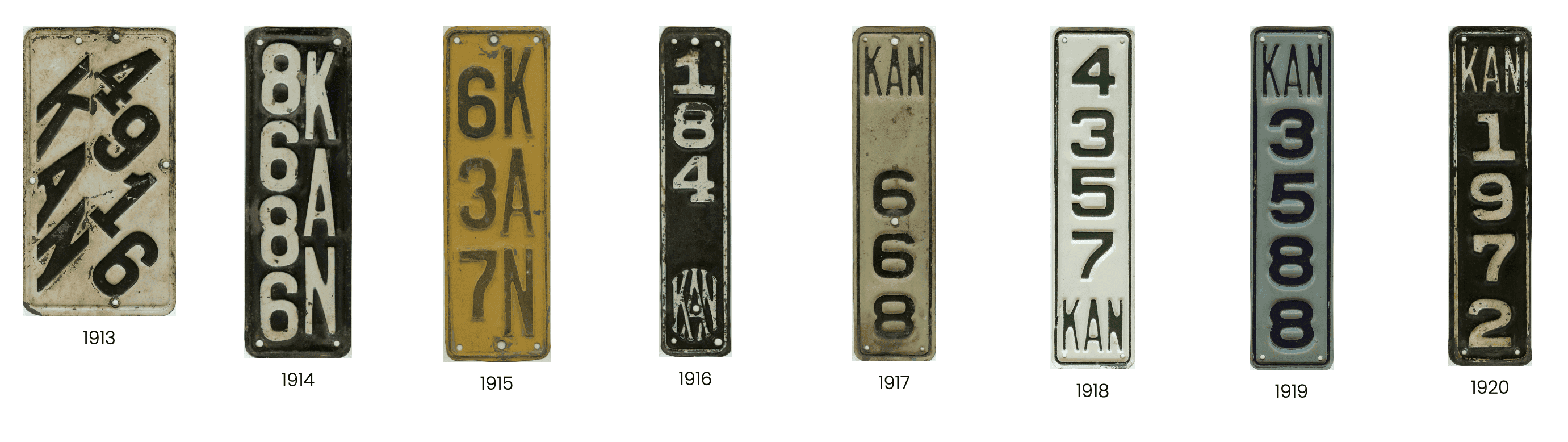
Like car plates, the first eight years of motorcycle plates are undated. The colors and the position of the “KAN” identify the year. The 1913 plate is unusual in that the characters are all slanted at an angle so the plate would be legible whether mounted vertically or horizontally.
Pre-County Code Era 1921-1960
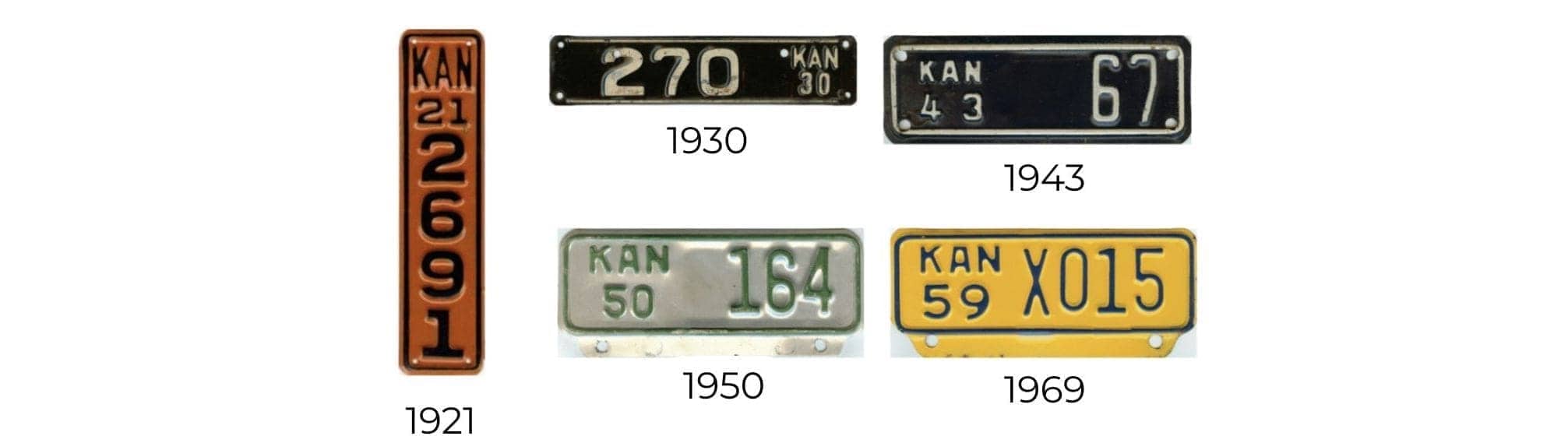
In 1921, motorcycle plates began to be dated. Kansas continued to use a vertical design through 1929. Starting in 1930, a horizontal design was adopted. In order to conserve metal during World War II, cars and trucks were issued a small tab in 1943. However, motorcycles got a full-size plate in 1943. The car and truck tabs were made of zinc coated steel, whereas motorcycle plates were painted white on dark blue. From 1950 through 1960, a mounting tab was added along the bottom of the motorcycle plate. By 1959, motorcycle registrations had increased to over 9,999. With room for only four numbers on the plate, this became a problem. The state’s solution was to substitute the letter X for 10,000. The plate number on the example pictured above is 10,015. Increased registrations in 1960 required the letter Y to be used for numbers in the 11,000 range.
Two Letter County Code Era 1961-Present
1961-1974


Starting in 1961, motorcycle plates began to be issued through the counties. The plate size was increased to 3 7/8 inches by 7 3/4 inches. This allowed room for a stacked two-letter county code on the left and the word CYCLE vertically on the right. Reflectorized paint for the embossed elements started in 1964 and was used through 1974.
1975-1988


Similar to trucks, multiyear plates started for motorcycles in 1975. The 1975 plate was used through 1979. The beginning design left off the word CYCLE, but later issues brought it back. The 1975 plate was replaced in 1980. Instead of the date embossed at the top of the plate like the 1975 plate, the 1980 plate featured a debossed “80” along the bottom edge. With the redesign of plates in 1982, new registrants of motorcycles received a blue-on-white reflectorized plate of the same design. Designs with the debossed “80” date, and with no date, were issued. Both the blue and the white plates were used through 1988.
1989-Present


1989 saw a new three-letter, two-number registration format begin. The two-letter county code continued to appear as a sticker on the left side, but was not a part of the actual registration. In 1994, the county-code sticker switched from blue on white to white on blue. This design was used through 2001. In 2002, the first motorcycle plate with a graphic was issued, featuring the state capitol. This design was issued into 2007. In 2007, a new design featuring the state seal was issued to new registrants. The format was reversed to two numbers followed by three letters. This design was replaced by a new design in 2025 that uses a two-letter, one-number, two-letter format.